



What If the Fastest Way to Calm Your Nervous System Was to Shock It?
It sounds counterintuitive: sit in searing heat, then plunge into cold water, and somehow walk away calmer than when you started. But ask anyone who practices contrast therapy regularly, and they’ll tell you the same thing — the discomfort is the point, and the payoff is real.
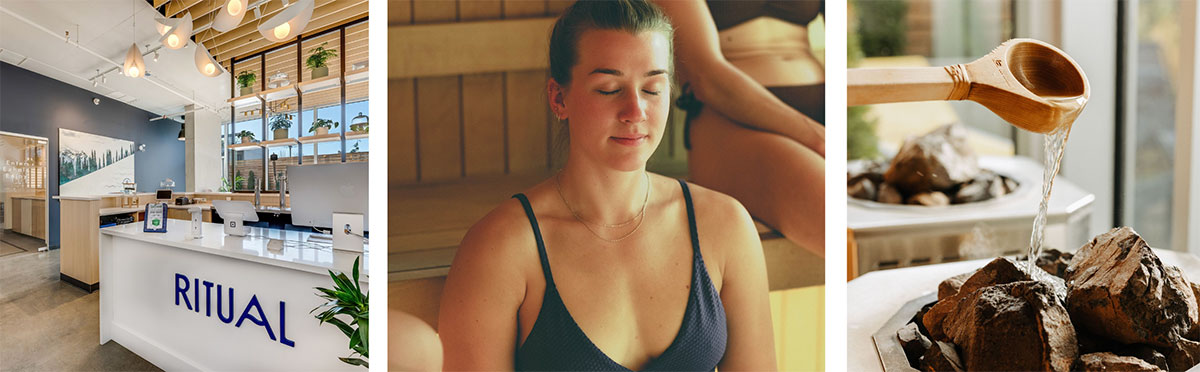
We put the question to two wellness professionals from Tall Tree Health after they visited Ritual Nordic Spa for a Nordic Circuit session.
Lucy Lee is a Registered Acupuncturist with a focus on women’s health, headaches, and neck pain, and Tanya Alton, a Registered Massage Therapist whose practice includes hydrotherapy, performance, and nervous system regulation. One works with contrast therapy occasionally; the other builds it into her practice on a regular basis. Together, their perspectives offer a healthcare-informed look at what heat and cold actually do for the body — in the moment, and over time.
The short-term effect: your nervous system hits reset
Ask either of them what stands out immediately after a session, and the word “calm” comes up fast.
“Feeling more calm while increasing a sense of resiliency” is what Lucy notices most during and after a Nordic Circuit. Tanya, who moves through hot-cold cycles frequently, describes something similar but more physiological: increased alertness, sharper cognitive clarity, and a nervous system that feels visibly downshifted.
That’s more than a feeling — it’s a mechanism. Heat encourages blood vessels to dilate, which supports circulation and can trigger a genuine stress-reduction response. Cold does the opposite, causing vessels to constrict, which helps manage inflammation and can leave you feeling more alert. Moving between the two, Lucy explains, is what makes the therapy work: “One extreme helps deal with the other extreme, and I leave feeling calm and rejuvenated.”
Tanya puts it more simply, and this is the line worth remembering: “Nothing is more powerful for my nervous system regulation, stress management, and a reset in baseline functioning.”
The long-term effect: benefits that compound. The short-term reset is what keeps people coming back — but the case for contrast therapy as a regular practice is where things get interesting.
Lucy points to benefits that build over time with consistent heat exposure: cardiovascular support and even cellular longevity, alongside stress reduction that accumulates session over session. “Add cold into the rotation regularly, and I’ve had clients report that it helps with their inflammation and pain relief” — benefits she describes less as a spa luxury and more as a therapeutic habit that happens to feel like a treat.
Tanya’s list goes further: improved sleep quality and an easier time falling asleep, better temperature regulation, improved circulatory and lymphatic function, decreased recovery time, and — something she flags as underappreciated — real support for mental health during the winter months. For clients dealing with seasonal low mood or sluggish cognition, she considers contrast therapy one of the more effective, low-barrier tools available.
An unexpected takeaway
Both professionals were asked what surprised them most about practicing contrast therapy regularly. Lucy’s answer was refreshingly honest: “It’s not as bad as you think it’s going to be.” The anticipation of the cold plunge, it turns out, is usually worse than the plunge itself — and what follows is a genuine sense of rejuvenation.
Contrast therapy isn’t just a spa indulgence dressed up as wellness. For those who see its effects both personally and in clinical practice, it’s a legitimate tool for nervous system regulation, inflammation management, circulation, sleep, and mental health — with benefits that show up immediately and deepen with regular practice.
As Tanya puts it, it may be one of the simplest ways to give your body a genuine reset. All it takes is a willingness to get uncomfortable first.